
Двигая промышленную
автоматизацию вперед
 г. Шымкент, ул. Алдиярова д. 74, кв. 12
Меню
г. Караганда, пр. Нуркена Абдирова, 5, Бизнес-центр, офисы 402, 403
Пн - Вс: с 09:00 до 18:00
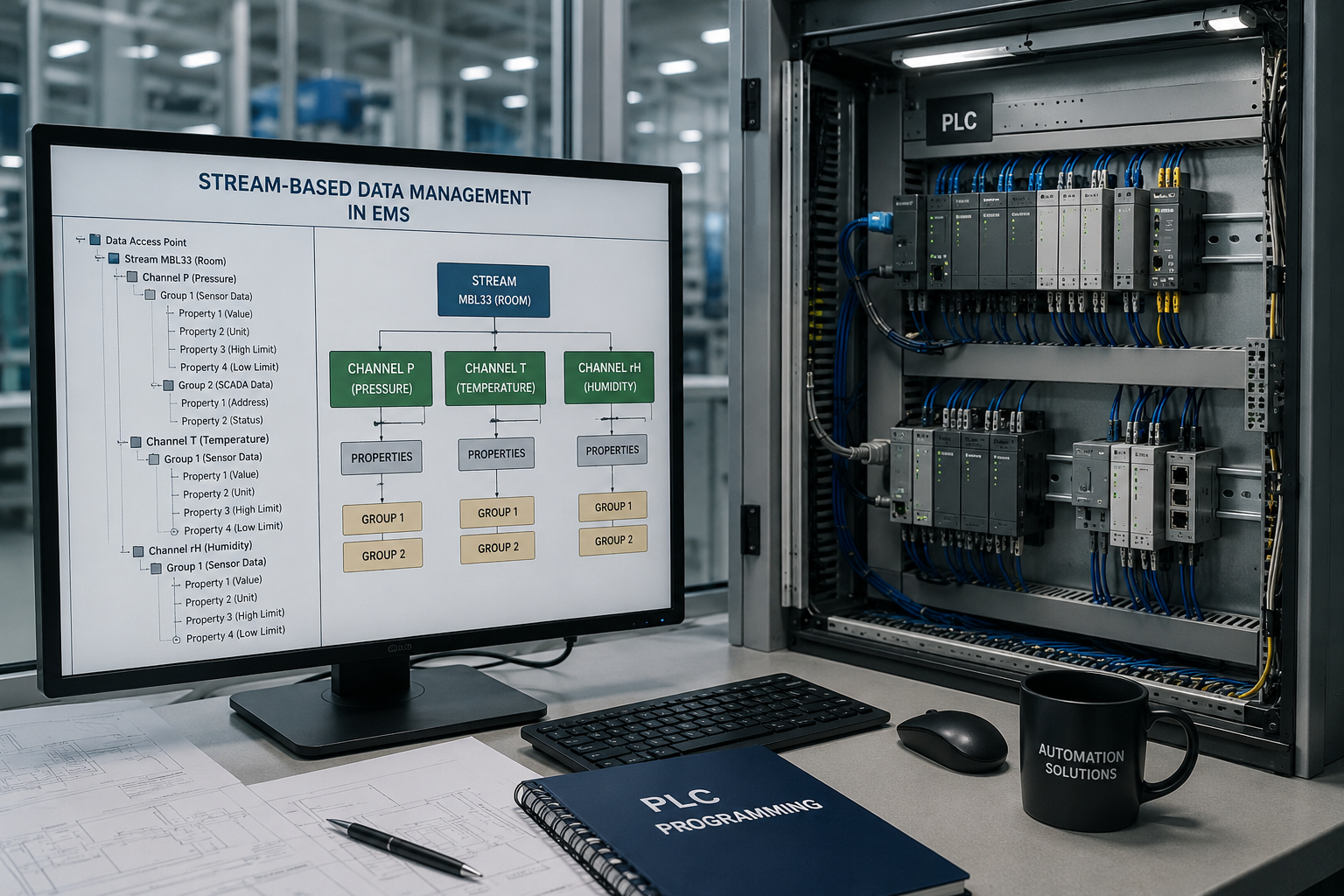
This article presents a modern approach to PLC programming for Environmental Monitoring Systems (EMS) used in pharmaceutical manufacturing. Based on practical experience gained during the implementation of multiple large-scale EMS projects, the author introduces a stream-based data management architecture designed to improve the scalability, transparency, and maintainability of PLC applications.
The proposed concept is built around the idea of a centralized “Data Access Point” — a unified global data structure containing all process-related information inside the PLC application. Within this architecture, process data is organized into Streams, Channels, and Properties. A Stream represents a monitored production object or area, such as a cleanroom. Channels correspond to specific monitored parameters, including pressure, temperature, and humidity. Properties contain the associated process values, alarm limits, visualization data, and communication parameters for SCADA, HMI, and other PLC systems.
The article demonstrates how this architecture can be implemented in CODESYS 3.5 using nested DUTs (Defined User Types), enabling highly structured and self-descriptive software design. The author explains how the stream-channel approach simplifies navigation through PLC code, standardizes processing mechanisms, and significantly reduces engineering complexity.
Special attention is given to the practical advantages of the methodology, including easier troubleshooting, improved readability of PLC programs, simplified scalability, and better compliance with GMP requirements in pharmaceutical environments. The article also discusses future development opportunities, such as integration with IIoT platforms, advanced analytics, predictive alarming, and enhanced cybersecurity.
Overall, the article demonstrates how modern software engineering principles can be successfully adapted to industrial automation and PLC programming, creating more efficient and future-ready EMS solutions.
 Назад
Назад